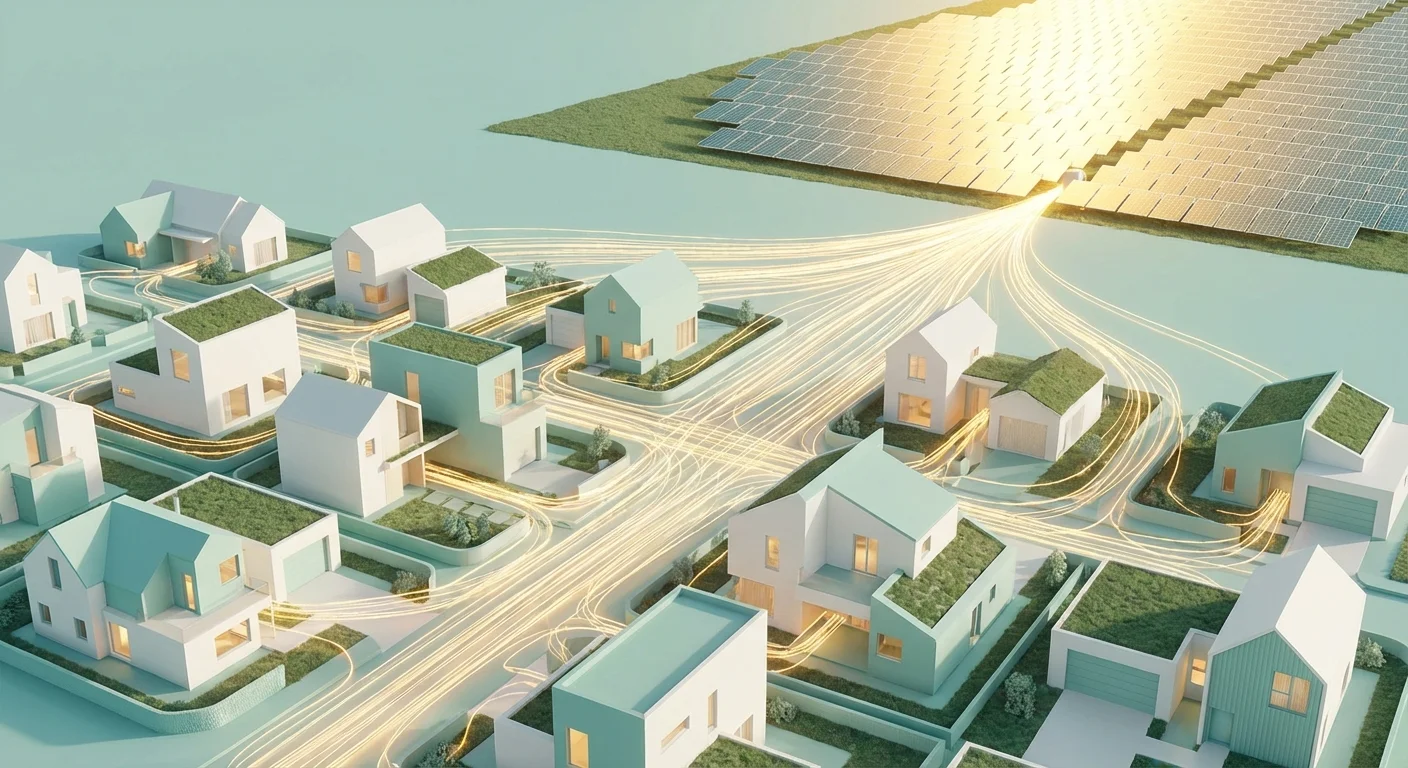
Your monthly utility bill arrives, and your eyes immediately dart to the bottom line. If it feels like that number climbs higher every season regardless of how often you nudge the thermostat, you are experiencing a trend reflected in national data. According to the Bureau of Labor Statistics, electricity prices for urban consumers have increased significantly over the last few years, often outpacing general inflation. For many households, the traditional solution—installing solar panels on the roof—remains out of reach due to a $15,000 to $25,000 price tag, a shaded backyard, or the simple fact that they rent their home.
Community solar offers a middle ground that bypasses these hurdles. It allows you to tap into the financial benefits of renewable energy without drilling a single hole in your roof or taking out a massive loan. By joining a shared solar project, you can secure a guaranteed discount on your monthly bill—typically ranging from 5% to 15%—simply by changing where your power comes from on paper. This approach moves solar from an exclusive luxury for homeowners to a practical savings tool for everyone.
Understanding the Mechanics of a Shared Sun
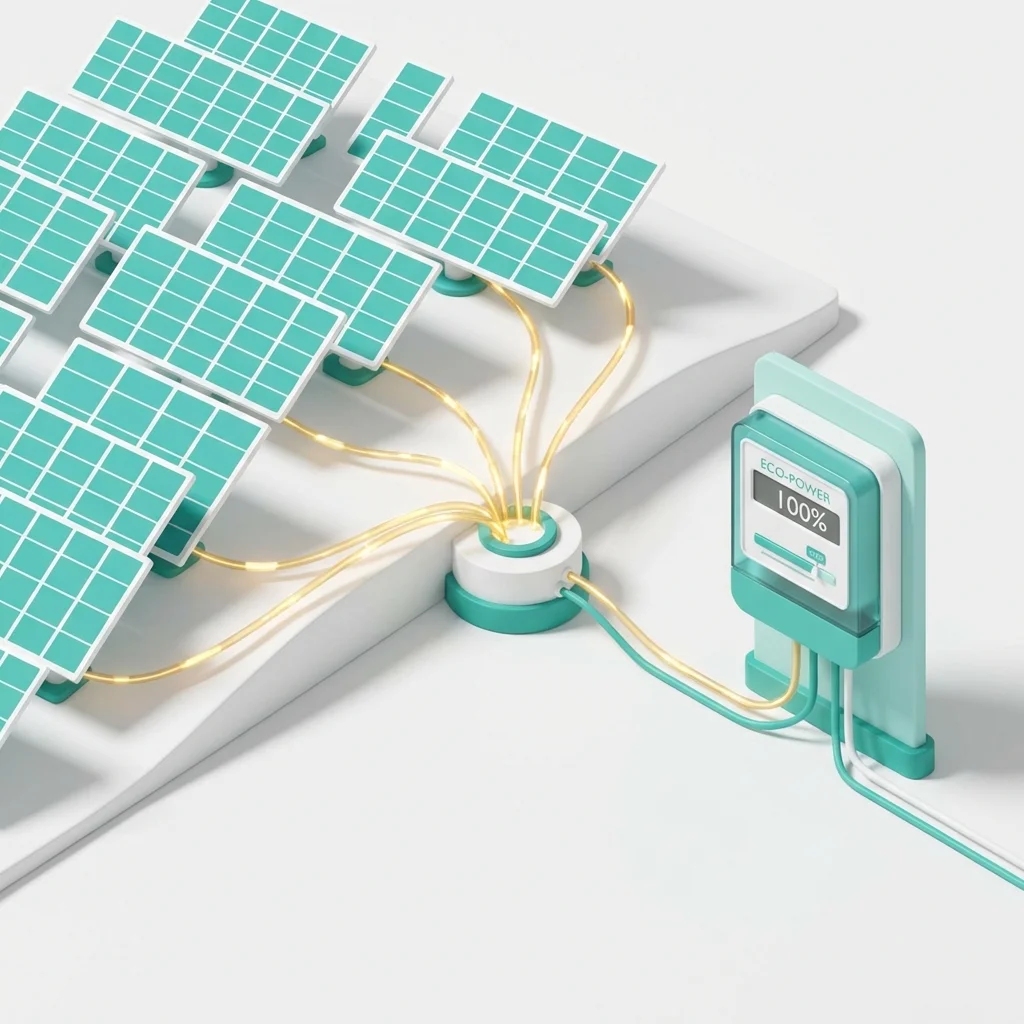
Community solar works through a “subscription” model. Instead of placing panels on your property, a developer builds a large solar farm on a capped landfill, a brownfield, or unused farmland within your utility’s territory. This farm generates electricity and feeds it directly into the local power grid. As a subscriber, you essentially “own” or “lease” a portion of the energy produced by that farm.
Your utility company tracks how much electricity your portion of the farm generates. They then apply a “Solar Credit” to your monthly electric bill, reducing the amount you owe them. In most cases, you pay the community solar provider for those credits at a discounted rate. For example, if the solar farm generates $100 worth of electricity for your share, the utility gives you a $100 credit. You then pay the solar provider roughly $85 or $90 for that credit. The $10 to $15 difference stays in your pocket as pure savings.
This process relies on a policy called “virtual net metering.” It ensures that even though the electrons from the solar farm might not flow directly into your toaster, you receive the financial equivalent of that power on your statement. It’s a seamless transition; your lights stay on even when the sun goes down because you remain connected to the standard utility grid. The solar farm simply offsets the cost of the energy you consume.
“The goal isn’t to be cheap—it’s to be intentional.”
Comparing Rooftop Solar vs. Community Solar
Choosing between these two options depends heavily on your living situation and financial goals. Rooftop solar is often a long-term investment that can eventually eliminate your bill, while community solar is a short-term savings strategy with no upfront cost. The following table breaks down the primary differences to help you decide which path fits your budget.
| Feature | Rooftop Solar Panels | Community Solar Subscription |
|---|---|---|
| Upfront Cost | High ($15,000–$30,000+) | $0 (Zero upfront cost) |
| Home Ownership | Required (Owners only) | Not required (Renters welcome) |
| Maintenance | Owner’s responsibility | Provider’s responsibility |
| Monthly Savings | 50% to 100% of bill | 5% to 15% of bill |
| Contract Length | 20–25 years (Equipment life) | Month-to-month or 1–5 years |
| Roof Condition | Must be sturdy and unshaded | Irrelevant to the program |

Why Community Solar is the “Great Equalizer” for Renters
For decades, the benefits of the “green revolution” were locked behind the gate of property ownership. If you lived in an apartment complex, a condo with a strict HOA, or a house shaded by massive oak trees, solar was an impossibility. Current estimates suggest that roughly 75% of American households cannot host a rooftop solar system for these reasons. Community solar for renters changes this dynamic entirely.
Because the subscription is tied to your utility account rather than your physical address, it is remarkably portable. If you move to a different apartment within the same utility service area, you can usually take your subscription with you. This flexibility is essential for the modern workforce and young families who may not stay in one place for 20 years. You get to support renewable energy and lower your electric bill without needing permission from a landlord to modify the building.
Furthermore, these programs often have lower barriers to entry regarding credit scores. While a solar loan for a rooftop system might require a “Prime” credit score, many community solar providers accept subscribers with a wider range of credit histories, making the savings accessible to more diverse income levels.

The Financial Breakdown: Tracking Your 15% Savings
To maximize your renewable energy savings, you must understand how the billing works. There are currently two main structures: Dual Billing and Consolidated Billing. Understanding which one your provider uses will prevent confusion when you see your first statement.
- Consolidated Billing: This is the gold standard for simplicity. You receive one bill from your utility company. The solar credit is subtracted directly from your total, and the discounted fee for the solar company is added. You pay one amount, and the savings are clearly visible.
- Dual Billing: You receive two bills. Your utility bill will show a large credit (e.g., -$100), significantly lowering what you owe the utility. You then receive a second bill from the solar provider for the discounted cost of that credit (e.g., $90). You must pay both to keep your account in good standing.
While dual billing requires an extra step, the math remains in your favor. If your average bill is $150 and you save 10%, you keep $15 every month. Over a year, that is $180—enough to cover a month of groceries or a significant portion of your car insurance. As Charles A. Jaffe famously noted, “It’s not your salary that makes you rich, it’s your spending habits.” Automating a 10% reduction in a fixed cost like electricity is a foundational smart-spending habit.

How to Find and Enroll in a Program
Availability varies by state. Currently, states like New York, Massachusetts, Illinois, Maryland, and Maine have some of the most robust community solar markets, though programs are expanding rapidly across the country. You can check the Energy.gov Savings Tips or the USA.gov Consumer Resources to find links to state-specific energy offices that list approved providers.
Follow these steps to get started:
- Check Eligibility: Visit a marketplace like EnergySage or search for “Community Solar [Your State]” to see which developers operate in your utility territory.
- Review Your Usage: Have a copy of your most recent electric bill handy. The provider will need your annual kilowatt-hour (kWh) usage to size your subscription correctly. You don’t want to subscribe to more power than you actually use.
- Compare “Discount Guarantees”: Look for programs that offer a “guaranteed discount.” This ensures that no matter how much the utility’s rates fluctuate, your solar credits will always cost you less than the utility’s retail rate.
- Read the Fine Print on Cancellations: While many modern programs offer “no-cost cancellation” with 30 to 90 days’ notice, some older contracts may have exit fees. Prioritize providers that offer flexibility.
- Sign Up: Enrollment usually happens online. You will provide your utility account number so the provider can link the credits to your bill.
“Beware of little expenses; a small leak will sink a great ship.” — Benjamin Franklin

Costly Mistakes to Avoid
While community solar is generally a low-risk way to lower your electric bill, you should stay vigilant to avoid common pitfalls. The most significant mistake is signing a contract without checking the escalation clause. Some contracts start with a high discount that shrinks over time. Always look for a fixed percentage discount that stays constant throughout the life of the agreement.
Another error is misunderstanding the “waiting period.” Solar farms take time to build. If you sign up for a project that is still under construction, you might not see savings for six months to a year. If you want immediate savings, look for a “live” project that is already operational and has open capacity.
Finally, do not confuse community solar with “Green Power” programs offered directly by your utility. Utility green power programs often charge you a premium (an extra $5 or $10 a month) to ensure your energy comes from renewable sources. Community solar is designed to give you a discount. If you are paying extra, you are in a different type of program.

Skip DIY When…
While we advocate for taking control of your finances, there are times when you should let the professionals handle the technical side of energy. Do not attempt to calculate your own complex solar offsets or negotiate custom rates with developers if you are unfamiliar with “Renewable Energy Certificates” (RECs). Most reputable community solar providers handle the REC management for you. This ensures that the environmental benefits are legally attributed to the project, allowing you to claim you are “using solar” without the legal headache of managing energy credits yourself.
Additionally, if your roof is in desperate need of repair, do not view rooftop solar as a “patch” for the problem. You must have a structurally sound roof to support panels for 25 years. In this scenario, skip the rooftop DIY research and go straight to community solar while you save for a new roof.
Frequently Asked Questions
Does community solar replace my current utility company?
No. Your local utility company (like ConEd, National Grid, or ComEd) still delivers the power to your home, maintains the wires, and handles repairs during outages. The community solar provider simply acts as the source of your energy credits.
What happens if it’s cloudy for a week?
The solar farm will produce less energy, and you will receive fewer credits that month. However, over the course of a year, these fluctuations balance out. Most providers size your subscription based on your average annual usage to ensure you get the maximum benefit across all four seasons.
Is there a credit score requirement?
This varies by provider. Many newer projects have eliminated credit score requirements to encourage wider participation, while some may still require a soft credit check (which does not impact your score) to verify your payment history.
Can I still use community solar if I have a “choice” electricity supplier?
In most states, yes. You can often keep your third-party supplier for the supply portion of your bill and still apply community solar credits to the delivery and total costs. However, check with your specific provider, as rules vary in deregulated markets like Illinois or Maryland.
Final Steps to Lower Your Bill
Taking control of your energy costs doesn’t require a construction crew or a massive bank account. By spending twenty minutes researching community solar programs in your area, you can effectively give yourself a 10% raise on your utility budget. It is one of the few “set it and forget it” financial moves that pays dividends every single month.
Start by grabbing your last three electric bills to find your average monthly usage. Head to a reputable comparison site or your state’s energy commission website to see which farms are currently accepting subscribers. Once you sign the digital agreement, the only thing left to do is monitor your statement for that first solar credit. Being intentional with your utility choice is a powerful step toward long-term financial stability.
The savings estimates in this article are based on typical costs and may differ in your area. Always compare current prices and consider your household’s specific needs.
Last updated: February 2026. Prices change frequently—verify current costs before purchasing.








Leave a Reply