
You walk into your local grocery store and head straight for the meat department. A pack of organic chicken breasts sits there, priced at $14.00. You look at your budget, sigh, and keep walking. But what if you could open an app on your phone and see that exact same package marked down to $7.00 simply because it reaches its “best by” date in two days? This is the reality of the surplus food economy.
The Bureau of Labor Statistics consistently reports that food is one of the largest categories of household spending, trailing only housing and transportation. According to recent Consumer Price Index data, grocery prices have remained stubbornly high, forcing many Americans to rethink how they fill their pantries. At the same time, the USDA estimates that between 30 and 40 percent of the food supply in the United States goes to waste. This disconnect creates a massive opportunity for you to save significant money while helping the environment.
Two major players, Flashfood and Too Good To Go, have turned this waste problem into a savings solution. By connecting consumers directly with surplus inventory, these apps allow you to rescue high-quality food at 50% to 70% off the retail price. If you want to cut your grocery bill without sacrificing the quality of your meals, mastering these platforms is a non-negotiable strategy.

The Mechanics of Flashfood: Grocery Savings in Real Time
Flashfood focuses primarily on the retail grocery environment. It partners with major chains—including Meijer, Giant, Stop & Shop, and Tops—to list items that are nearing their expiration dates. Unlike traditional “manager’s specials” where you have to hunt through every aisle to find a yellow sticker, Flashfood aggregates these discounts into a single digital storefront.
When you open the app, you see a map of participating stores in your area. Clicking on a store reveals a list of specific items available for purchase. You might find a $20 beef roast for $10, a $5 gallon of organic milk for $2, or a “Fruit and Veggie Box” containing 10–15 pounds of produce for a flat $5. You purchase these items directly through the app using your credit card or digital wallet.
Once you buy the items, you head to the store and look for the purple Flashfood zone. This is typically a dedicated refrigerator and rack located near the front of the store or the customer service desk. You simply grab your items, show your digital receipt to a store employee, and walk out. You skip the checkout lines entirely because you have already paid. It transforms the often-frustrating hunt for discounts into a streamlined, high-tech experience.

Decoding the Too Good To Go “Surprise Bag”
While Flashfood lets you pick individual items, Too Good To Go operates on the “Surprise Bag” model. This app partners with a broader range of businesses, including restaurants, bakeries, cafes, and recently, national grocery chains like Whole Foods. The premise is simple: businesses have leftover food at the end of their shift or day, and they pack it into a bag for a third of its retail value.
If you see a “Pastry Bag” from a local bakery listed for $4.99, you are guaranteed at least $15 worth of value. The catch? You don’t know exactly what is inside until you pick it up. You might get four chocolate croissants, or you might get a loaf of sourdough and three muffins. This model requires a bit more flexibility in your meal planning, but the savings are unparalleled.
Too Good To Go has expanded rapidly across major U.S. cities. It is particularly effective for prepared foods. Many users find that a single $6.00 “Surprise Bag” from a local prepared-foods deli can provide two full dinners. The app also features “Best Before” bags from convenience stores and smaller grocers, often containing snacks, drinks, and pantry staples that are approaching their sell-by dates.
“The goal isn’t to be cheap—it’s to be intentional.”

Comparing the Giants: Which App Fits Your Lifestyle?
Choosing between these two platforms—or deciding how to use them together—depends on your shopping habits and how much control you need over your ingredients. Flashfood is generally better for meal prepping and household staples, while Too Good To Go is better for treats, ready-to-eat meals, and adventurous eaters.
| Feature | Flashfood | Too Good To Go |
|---|---|---|
| Inventory Style | Specific items (you choose what you buy) | Surprise bags (contents unknown until pickup) |
| Primary Partners | Large grocery chains (Meijer, Giant, Tops) | Restaurants, bakeries, Whole Foods, cafes |
| Average Discount | 50% off | 66% – 75% off |
| Best For | Meat, produce, dairy, and pantry staples | Prepared meals, bread, pastries, and snacks |
| Pickup Window | Usually anytime during store hours | Specific windows (often near closing time) |
If you have a large family to feed, Flashfood is likely your primary tool. Being able to see that a store has five packs of ground beef at half price allows you to plan a week of dinners and lock in those savings before you even leave your house. Conversely, if you are a busy professional looking for a cheap, high-quality dinner after work, Too Good To Go offers restaurant-quality food for less than the cost of a fast-food value meal.
Advanced Strategies to Maximize Your Savings
Simply downloading the apps isn’t enough to secure the best deals. You are competing with thousands of other savvy shoppers. To truly slash your bills by 50% or more, you must treat these apps with a tactical mindset.
- Enable Push Notifications: The best deals on Flashfood—especially the $5 produce boxes—disappear within minutes of being posted. Go into your phone settings and ensure these apps can alert you immediately.
- Learn the Posting Patterns: Most stores have a routine. A grocery store might update their Flashfood inventory at 8:00 AM every morning after their overnight crew finishes stocking. A local bakery might post their Too Good To Go bags exactly two hours before closing. Monitor your favorite locations for three days to identify these “drop times.”
- Check the “Flashfood Zone” Manually: Occasionally, store employees mark items down in the app but forget to move them to the purple bin. If you see an item in the app but can’t find it in the bin, check the regular shelf. The app price still applies if you buy it through the platform.
- Bring an Insulated Bag: Since you are buying items nearing their expiration, temperature control is vital. Keep a cooler or insulated bag in your car to ensure meat and dairy stay at safe temperatures during your drive home.
- Freeze Immediately: The secret to using 50% off meat is the freezer. When you buy “use by today” chicken from Flashfood, you aren’t required to cook it today. Label it and toss it in the freezer the moment you get home to stop the clock on spoilage.

Costly Mistakes to Avoid
Saving money on surplus food is only a win if you actually consume what you buy. It is easy to get caught up in the thrill of a 70% discount and overspend on items you don’t need or can’t use.
Buying for the discount, not the need. A $2.00 jar of specialty horseradish is a great deal, but if you don’t like horseradish, you just wasted $2.00. Stick to your usual grocery list and only use surplus apps to fill those specific needs or to swap out expensive proteins for cheaper surplus versions.
Ignoring the “Best By” vs. “Use By” distinction. According to the Federal Trade Commission and the USDA, most date labels on food refer to quality, not safety. However, you must still use your senses. If you buy a Surprise Bag and the contents look or smell off, do not risk your health. Most apps have a refund process for food that is truly inedible.
Underestimating the “Surprise” in Surprise Bags. If you have severe food allergies, Too Good To Go can be risky. Because the employees are packing whatever is left over at the end of the night, they cannot always guarantee the absence of allergens like nuts or dairy. If your dietary restrictions are strict, stick to Flashfood where you can read the ingredient labels before you buy.
Missing your pickup window. Too Good To Go is very strict about pickup times. If a bakery says you must pick up between 8:30 PM and 9:00 PM and you show up at 9:05 PM, they may have already locked the doors. You will likely still be charged, and you’ll go home empty-handed. Set an alarm on your phone for 15 minutes before the window starts.

Skip DIY When…
While rescuing surplus food is a powerful financial move, there are specific scenarios where it is better to stick to traditional shopping methods. You should skip these apps when:
- You are on a very strict therapeutic diet. If you are managing a condition that requires precise macronutrient ratios or specific ingredients, the unpredictability of surplus bags will disrupt your progress.
- The “savings” require excessive travel. If you have to drive 20 miles round-trip to save $5 on a Flashfood box, the cost of gas and the value of your time will likely negate the savings. Check AAA Gas Prices to calculate your per-mile cost before making a dedicated trip.
- You struggle with food waste at home. If your refrigerator is already full of “good intentions” that eventually turn into science experiments, adding more short-dated food will only increase your waste. Clean out your pantry and fridge before you start adding surplus items.
“It’s not your salary that makes you rich, it’s your spending habits.” — Charles A. Jaffe

Practical Meal Planning Around Surplus
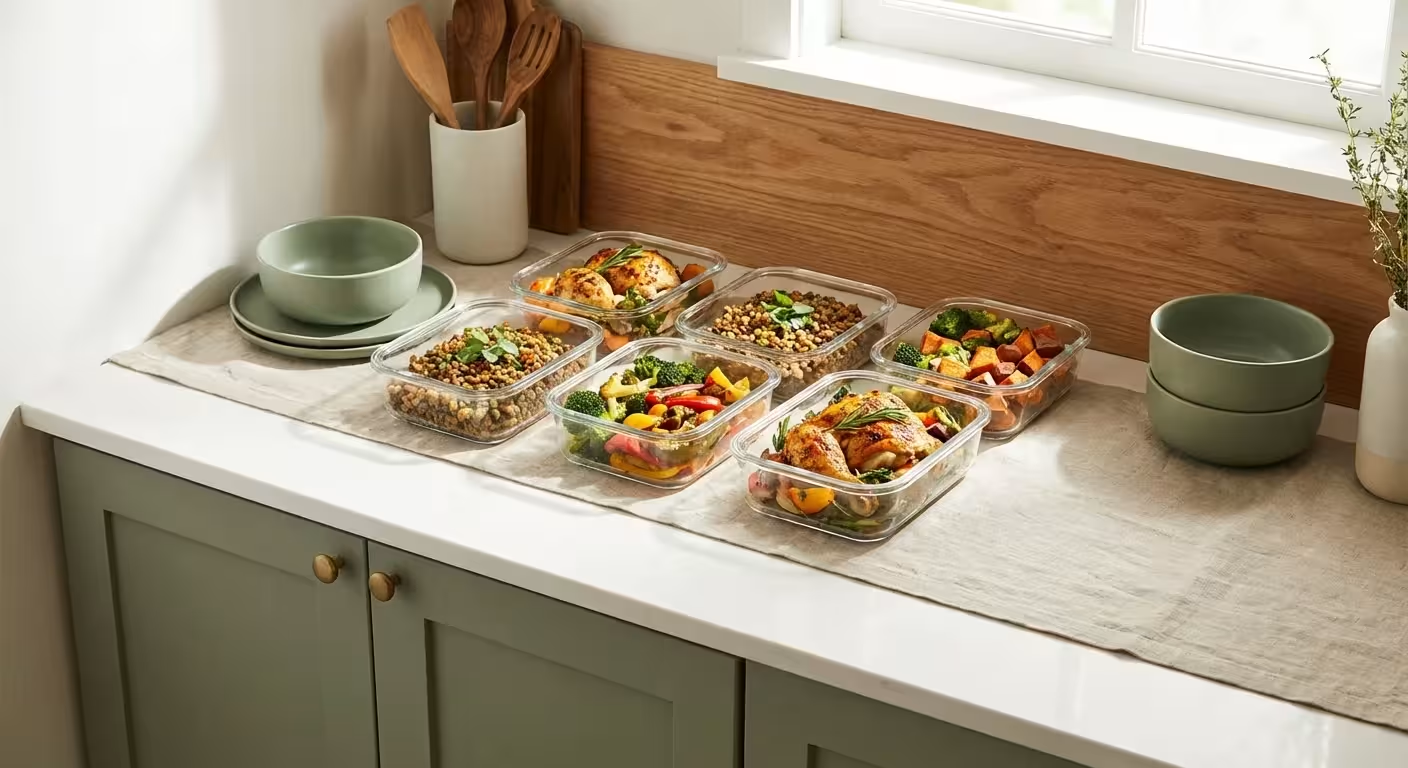
To get the most value, flip your meal planning process on its head. Instead of picking a recipe and then shopping for ingredients, check your apps first to see what is available at a deep discount, then build your meal around those items.
If Flashfood has a large quantity of bell peppers and onions marked down, that is your signal to make fajitas or a large batch of stir-fry. If you snag a Too Good To Go bag from a pizza shop that includes extra dough or toppings, you have an impromptu “pizza night” for a fraction of the usual cost. This “reverse meal planning” keeps your kitchen creative and your bank account full.
Using these apps also allows you to afford higher-quality items that might otherwise be out of reach. Many users report being able to buy organic, grass-fed beef or high-end artisanal cheeses through Flashfood for the same price they would normally pay for the “budget” versions. It is a way to upgrade your lifestyle without upgrading your spending.
Frequently Asked Questions
Are the items on Flashfood safe to eat?
Yes. Retailers are legally and reputationally motivated to sell only safe food. The items listed on Flashfood are generally nearing their “Best By” date, which is a manufacturer’s estimate of peak quality, not a safety expiration. Always inspect meat and dairy as you would with any purchase, and freeze them if you don’t plan to use them immediately.
Can I use SNAP/EBT on these apps?
Currently, Flashfood and Too Good To Go primarily accept credit cards, debit cards, and digital payments like Apple Pay or Google Pay. While some grocery stores are working toward EBT integration for online platforms, it is not yet universally available for these specific surplus apps. Check the app settings for the most current payment options in your region.
What if the store can’t find my Flashfood order?
This happens occasionally if a new employee is working. Politely ask them to check the purple Flashfood refrigerator or the customer service holding area. If the order is truly missing, you can flag the issue directly in the app. Flashfood is known for having a responsive customer support team that issues refunds quickly for missing items.
Do I need to tip for Too Good To Go bags?
Tipping is not required or expected for surplus bag pickups, as there is no table service involved. However, if you are picking up from a small local business and you appreciate the value they provide, some people choose to buy an extra coffee or a small item to support the shop, though this is entirely optional.
Taking Your First Step Toward 50% Savings
The easiest way to start is to download both apps today and simply observe. Don’t feel pressured to buy something immediately. Spend a few days checking the inventory at different times. You will quickly notice which stores in your neighborhood are the most generous and which ones post items that align with your family’s tastes.
Start small. Try a $5 veggie box from Flashfood or a single pastry bag from a nearby bakery. Once you see the quality and the volume of food you receive for such a low price, the “sticker shock” of full-priced groceries becomes much harder to swallow. By making surplus shopping a regular part of your routine, you can easily save $100 to $200 per month on your grocery bill.
This article provides general money-saving guidance. Individual results vary based on location, household size, and spending patterns. Verify current prices before making purchasing decisions.
Last updated: February 2026. Prices change frequently—verify current costs before purchasing.




Leave a Reply