
Your emergency fund sits in a traditional savings account, quietly losing its purchasing power while inflation climbs. Most people treat their “rainy day” fund like a pile of cash under a mattress—safe, accessible, but fundamentally unproductive. If you have $10,000 parked in a standard big-bank savings account, you might be earning a dismal 0.01% interest. That amounts to a single dollar after an entire year of waiting. Meanwhile, the Bureau of Labor Statistics frequently reports inflation rates that far outpace those meager returns; this means your “safe” money is actually shrinking in value every single day.
You need a way to protect your principal while capturing the higher yields usually reserved for long-term investments. Enter the certificate of deposit (CD) ladder. This strategy balances the need for liquidity—having cash ready when the water heater bursts—with the desire to earn more interest than a standard savings account provides. By staggering your investments, you ensure that a portion of your cash is always becoming available, while the rest works hard at a locked-in, high-interest rate.

Understanding the Mechanics of CD Laddering
A certificate of deposit is a specialized savings account that holds a fixed amount of money for a fixed period of time—such as six months, one year, or five years. In exchange for promising not to touch the money, the bank pays you a higher interest rate than you would get in a regular savings or money market account. The trade-off is accessibility; if you pull your money out early, you generally face an early withdrawal penalty that can eat into your interest or even your principal.
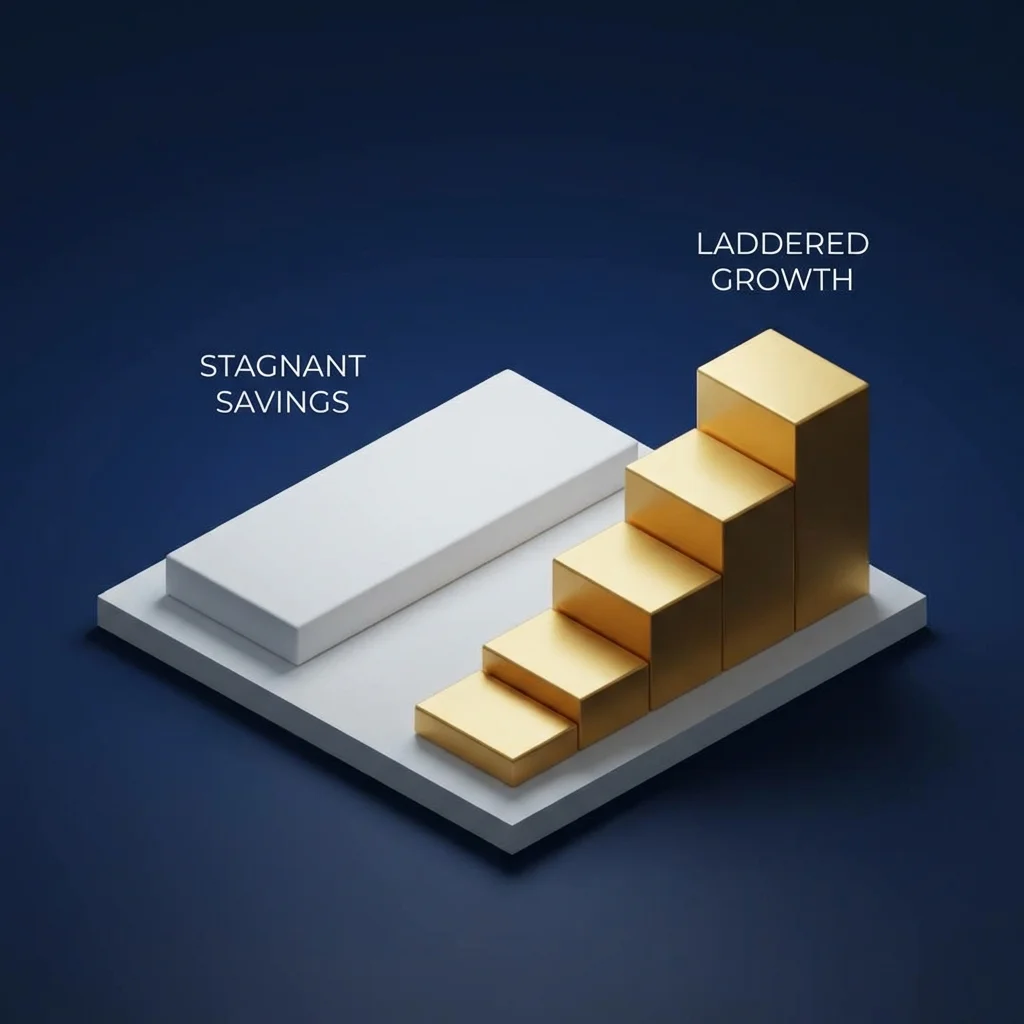
CD laddering solves this accessibility problem by breaking your total investment into smaller chunks and spread across different maturity dates. Instead of putting $20,000 into a single five-year CD, you might put $4,000 into five different CDs with terms of one, two, three, four, and five years. As the one-year CD matures, you reinvest it into a new five-year CD. Eventually, you have a “rolling” system where a high-interest CD matures every single year, providing you with a predictable stream of liquid cash without sacrificing the long-term yield of the rest of your portfolio.
“The goal isn’t to be cheap—it’s to be intentional.” — Unknown
This intentionality allows you to stop worrying about whether interest rates will rise or fall tomorrow. If rates go up, your next maturing “rung” on the ladder can be reinvested at those higher rates. If rates go down, you have already locked in your higher rates for the remaining rungs of your ladder. It is a self-correcting system designed for the pragmatic saver.

Why Your Emergency Fund Needs This Structure
Standard financial advice suggests keeping three to six months of living expenses in a liquid account. However, keeping that entire sum in a 0.50% high-yield savings account (HYSA) is often a missed opportunity. While an HYSA is great for immediate needs, your emergency fund is rarely spent all at once. Most emergencies—a car repair, a medical deductible, or a temporary job loss—happen in stages or have specific price tags that don’t require your entire life savings in one afternoon.
By using a CD ladder, you keep a portion of your fund in a liquid savings account for immediate “Stage 1” emergencies, while the rest moves into the ladder. This tiered approach maximizes your yield. According to data from the Consumer Financial Protection Bureau, understanding the terms of your financial products is the first step toward building true consumer wealth. CDs are one of the most transparent tools available; they are FDIC-insured up to $250,000 per depositor, per insured bank, making them just as safe as your standard checking account.

How to Build Your First 12-Month Emergency Ladder
If you are new to this strategy, a 12-month ladder is the perfect entry point. It provides high frequency—cash becomes available every three months—while still capturing better rates than a standard savings account. Let’s look at how you would structure a $10,000 emergency fund using this method.
- Step 1: Keep $2,000 in a traditional high-yield savings account for immediate “right now” emergencies.
- Step 2: Open a 3-month CD with $2,000.
- Step 3: Open a 6-month CD with $2,000.
- Step 4: Open a 9-month CD with $2,000.
- Step 5: Open a 12-month CD with $2,000.
Three months from today, your first CD matures. If you don’t need the cash for an emergency, you reinvest that $2,000 (plus the interest earned) into a new 12-month CD. Three months after that, your 6-month CD matures, and you move that into a new 12-month CD as well. Within a year, you will have four 12-month CDs, but one will be maturing every 90 days. You have effectively achieved the high interest rate of a 1-year commitment with the liquidity of a 3-month commitment.
Comparing Your Options: Where to Park Your Cash
Deciding where to put your money depends on your specific needs for growth versus access. Below is a comparison of common vehicles for emergency funds and how they stack up against the CD ladder strategy.
| Feature | Standard Savings | High-Yield Savings (HYSA) | Individual CD | CD Ladder |
|---|---|---|---|---|
| Interest Rate | Very Low (approx. 0.01%) | Moderate (variable) | High (fixed) | High (fixed & staggered) |
| Liquidity | Instant | Instant (usually) | Low (penalty for early exit) | Periodic (at maturity) |
| Risk | Low (FDIC Insured) | Low (FDIC Insured) | Low (FDIC Insured) | Low (FDIC Insured) |
| Rate Protection | None | None (rates can drop) | Guaranteed for term | Diversified across terms |
The CD ladder offers a unique middle ground. While a money market account or a high-yield savings account might offer competitive rates today, those rates can vanish overnight if the Federal Reserve decides to cut interest rates. When you open a CD, you are signing a contract; the bank must pay you that rate for the duration of the term, regardless of what happens in the wider economy.

When It’s Worth Paying: Early Withdrawal and Higher Yields
There are specific scenarios where you might intentionally break your ladder or pay a fee. It sounds counterintuitive to pay a bank a penalty to get your own money back, but professional savers look at the “break-even” point. If interest rates spike significantly—say, by 2% or 3%—it might actually be more profitable to pay a three-month interest penalty on your old, low-rate CD to move that capital into a new, high-rate CD.
You should also consider “No-Penalty CDs.” These specialized products, often highlighted by resources like NerdWallet, allow you to withdraw your full balance and interest after a short initial period (often 7 days) without any fees. While the interest rates on no-penalty CDs are slightly lower than traditional CDs, they are significantly higher than standard savings. They serve as excellent “buffer” rungs for the bottom of your ladder.

Don’t Fall For These Common CD Mistakes
While the CD ladder is a robust strategy, a few pitfalls can derail your savings progress. You must be proactive to ensure your money stays working for you without unnecessary friction.
- Ignoring the Auto-Renewal Trap: Most banks automatically “roll over” your CD into a new one of the same term once it matures. Often, this default renewal happens at a much lower “standard” rate rather than the promotional rate you initially received. Always set a calendar alert for 10 days before maturity so you can shop for the best current rate.
- Forgetting the Tax Man: The interest you earn on a CD is considered taxable income in the year it is earned—even if you haven’t actually withdrawn the money from the CD yet. If you are building a large ladder, keep a small portion of your earnings set aside for your annual tax bill.
- Locking Up Too Much: Never put your “rent and groceries” money into a CD. The ladder is for the money you might need, not the money you will need next Tuesday. Always maintain a liquid base in a checking or savings account.
- Ignoring Online Banks: Traditional brick-and-mortar banks have high overhead and often offer insulting interest rates. Online-only institutions frequently offer rates that are 10 to 20 times higher. Verify any bank through the USA.gov Consumer Resources to ensure they are legitimate and insured.

Advanced Laddering: The Barbell and the Bullet
Once you master the basic ladder, you can tailor the structure to your specific economic outlook. If you believe interest rates are at an all-time peak and will soon drop, you might use a Bullet Strategy. This involves opening several CDs of different lengths that all mature at the same time—the “target date”—allowing you to have a massive influx of cash when you anticipate needing it, such as for a home down payment.
Conversely, if you want to hedge against volatility, the Barbell Strategy involves putting half of your money into very short-term CDs (for liquidity) and half into very long-term CDs (for maximum yield). You ignore the middle terms entirely. This protects you if rates rise (because you have short-term cash to reinvest) and if rates fall (because you have locked in long-term high yields on the other half).
Frequently Asked Questions
Can I add money to a CD after it is opened?
Generally, no. Most certificates of deposit are “single-deposit” accounts. If you want to save more, you usually have to open a new CD. This is why the laddering strategy works so well; it encourages you to open new accounts regularly, allowing you to capture the best rates available at that moment.
What happens if the bank goes out of business?
As long as your bank is FDIC-insured (or NCUA-insured for credit unions), your principal and earned interest are protected up to $250,000. Before opening any account, use the FDIC’s “BankFind” tool to verify the institution’s status. This makes CDs one of the safest places for Americans to store their wealth.
Is a CD ladder better than investing in the stock market?
They serve different purposes. The stock market is for long-term wealth building (10+ years) and comes with the risk of losing principal. A CD ladder is for capital preservation and short-to-medium-term needs. Your emergency fund should never be in the stock market because you don’t want to be forced to sell your stocks when the market is down just because your car broke down.
How many “rungs” should my ladder have?
For most people, four to six rungs are the “sweet spot.” This provides enough frequency that you aren’t waiting too long for a maturity date, but the amounts in each rung are large enough to make the interest earnings feel substantial. If you have a very large emergency fund, you might expand to a 12-rung ladder with a CD maturing every single month.
Start Small and Scale Your Savings
You do not need $50,000 to start a CD ladder. Many online banks allow you to open CDs with as little as $500. Start by taking just $1,000 of your current savings and splitting it into two $500 CDs—one for six months and one for twelve months. As you get comfortable with the rhythm of maturity dates and reinvestment, you can move more of your stagnant cash into the ladder.
Building a CD ladder is a declaration of financial independence from low-interest big banks. It requires about 15 minutes of administrative work every few months, but the payoff is a resilient, high-yielding emergency fund that grows while you sleep. Take a look at your current savings account yield today; if it starts with “0.0,” it is time to start building your ladder.
This article provides general money-saving guidance. Individual results vary based on location, household size, and spending patterns. Verify current prices and interest rates before making purchasing decisions.
Last updated: February 2026. Prices change frequently—verify current costs before purchasing.









Leave a Reply