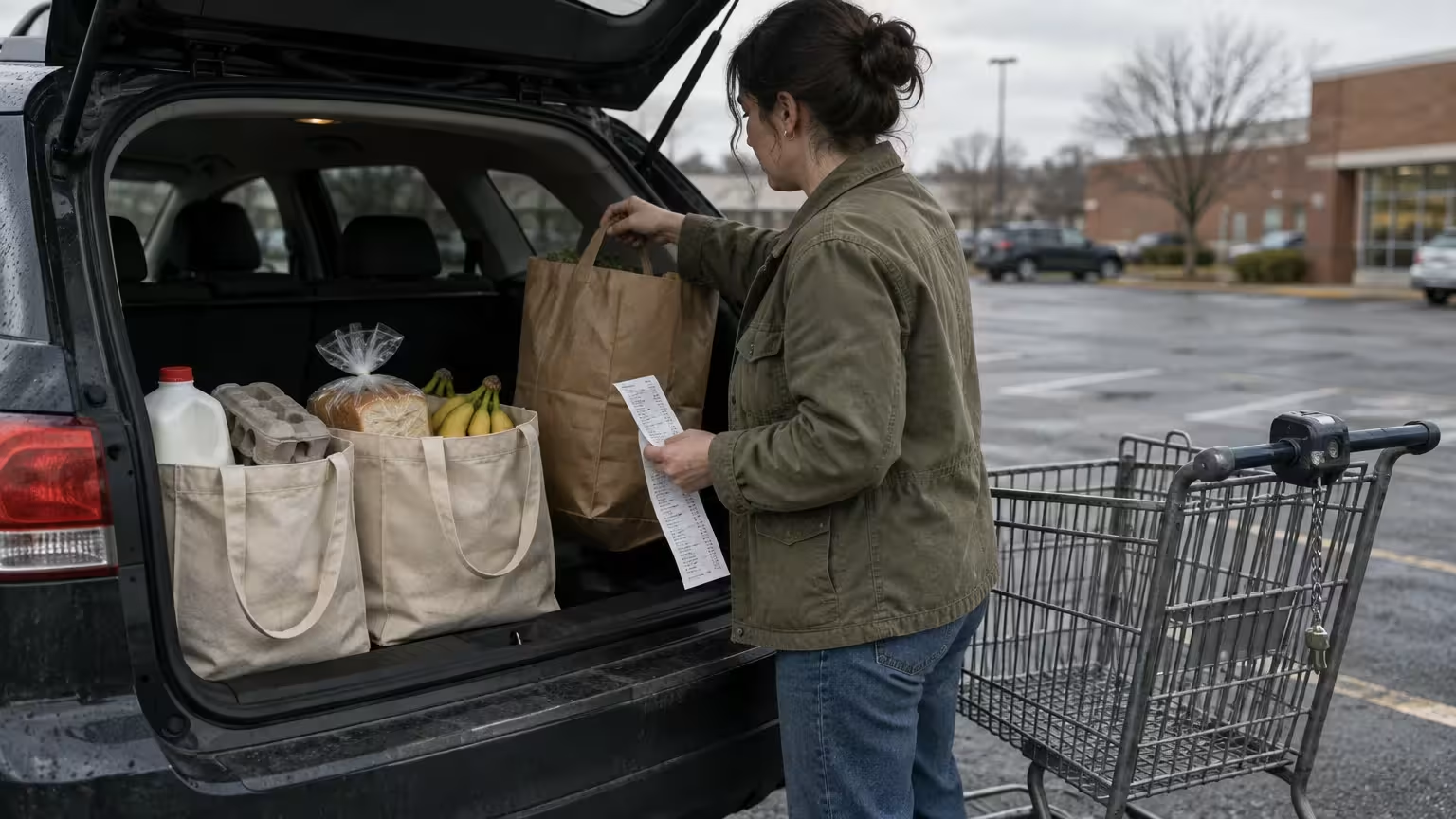
A household on a $600 monthly grocery budget can lose money switching grocers when extra miles erase the savings. With USDA forecasters expecting food-at-home prices to rise about 2.3% in 2026, route and cart decide the winner.
Moving 70% of a $600 grocery budget to Aldi or Lidl at a 5% price gap saves only $21 a month. Because a weekly 20-mile round trip burns roughly $11 in gas, switching backfires unless net monthly savings top $15.
Match Your Grocery Budget, Cart, and Drive to the Cheapest Store
Compare your cart, budget, and drive against the four rows below before changing grocers. Each row pairs a common household setup with the chain that leaves more cash after fuel.
| Household route and cart | Best store move | Price edge in our benchmark | What protects or breaks savings |
|---|---|---|---|
| Store-brand staples near an Aldi without an extra drive | Make Aldi your primary store | $41.61 vs. $45.78 at Walmart on 15 staples (about 9% less) | Bring bags and a 25-cent cart deposit; skip center-aisle Finds |
| Fresh meat, eggs, dairy, and bakery on the East Coast | Shop Lidl along an existing route | $42.12 vs. $45.78 at Walmart (lowest on 7 of 15 items) | Use the Lidl Plus app; pass on weekly non-food specials |
| National brands, specialty diets, or a 20-mile drive to discounters | Stay at Walmart for one-stop trips | Lower prices on exact brands; avoids $11 monthly fuel cost | Try Great Value swaps or weigh Walmart+ fee against fuel |
| Mixed cart ($600 to $1,000 budget) moving 70% to store brands | Split high-gap staples at Aldi or Lidl with Walmart runs | $21 to $70 a month ($252 to $840 a year) before gas | Move categories only when savings after fuel top $15 a month |
Make Aldi Your Primary Store for High-Gap Store Brands
If your household already passes an Aldi and buys mostly store-brand staples, Aldi delivers the lowest overall bill. Aldi and Lidl keep shelf tags low through a limited-assortment model that stocks one or two versions of each staple.
Fewer products create greater buying volume per item and require smaller stores to light, staff, and restock. Aldi also cuts store labor by shelving many goods directly inside their shipping cases.
Shoppers pay a 25-cent refundable cart deposit so staff don’t have to round up carts and pack their own groceries. Keeping reusable bags in the car prevents small checkout bag fees from chipping away at weekly savings.
On an illustrative fall 2026 basket of 15 store-brand staples, Aldi totals $41.61 versus $42.12 at Lidl and $45.78 at Walmart. Local prices vary by week, yet Aldi beats Walmart by $4.17, or about 9%, and edges Lidl by $0.51.
Aldi’s largest price leads over Walmart (53 to 72 cents per item) cluster in butter, ground coffee, olive oil, and paper towels. Aldi wins seven basket items outright and ties Lidl on canned beans:
- Salted butter (1 lb): Aldi $3.45 ($3.45/lb), Lidl $3.50, Walmart $3.98.
- Peanut butter (16 oz): Aldi $1.85 (11.6¢/oz), Lidl $1.89, Walmart $1.94.
- White rice (5 lb): Aldi $3.10 (62¢/lb), Lidl $3.20, Walmart $3.44.
- Ground coffee (12 oz): Aldi $4.25 (35.4¢/oz), Lidl $4.40, Walmart $4.88.
- Frozen pepperoni pizza (1): Aldi $3.50 ($3.50 each), Lidl $3.65, Walmart $3.97.
- Olive oil (16.9 fl oz): Aldi $5.45 (32.2¢/fl oz), Lidl $5.50, Walmart $6.12.
- Paper towels (6 rolls): Aldi $6.50 ($1.08/roll), Lidl $6.75, Walmart $7.22.
- Canned beans (15 oz): Aldi and Lidl tie at $0.79 (5.3¢/oz), Walmart $0.82.
Because package weights vary across grocers, compare the price per ounce or pound rather than the shelf tag. Our guide to calculating cost per ounce shows how to spot real savings fast in the aisle.
For shoppers tracking additives, Aldi US says it has removed certified synthetic colors, added MSG and partially hydrogenated oils from its exclusive brands. That is a voluntary company policy, and European food law does not govern products made for US stores.
Trying unfamiliar labels on a $600 monthly budget carries minimal financial risk at Aldi. Its Twice as Nice Guarantee replaces most exclusive-brand products and refunds your money with a receipt if an item disappoints.
Use Lidl for Fresh Staples When East Coast Routes Line Up
Households near a Lidl often come out ahead when fresh meat, dairy, produce, and bakery items fill their weekly cart. Lidl stores are concentrated in East Coast states, so this option only works if one sits near your routine errands.
In the 15-item illustrative basket, Lidl beats both Aldi and Walmart on seven fresh and pantry staples:
- Whole milk (1 gal): Lidl $3.12 (2.4¢/fl oz), Aldi $3.15, Walmart $3.28.
- Large eggs (dozen): Lidl $1.99 (16.6¢/egg), Aldi $2.05, Walmart $2.12.
- White sandwich bread (20 oz): Lidl $1.20 (6.0¢/oz), Aldi $1.25, Walmart $1.32.
- Chicken breast (1 lb): Lidl $2.65 ($2.65/lb), Aldi $2.69, Walmart $2.97.
- Bananas (per lb): Lidl $0.46 ($0.46/lb), Aldi $0.48, Walmart $0.52.
- Spaghetti (16 oz): Lidl $0.92 (5.8¢/oz), Aldi $0.95, Walmart $0.98.
- Shredded cheese (8 oz): Lidl $2.10 (26.3¢/oz), Aldi $2.15, Walmart $2.22.
Member coupons now run through the Lidl Plus app, which replaced the older myLidl app. Pairing those app specials with Lidl’s in-store bakery and weekly meat deals widens its edge on fresh runs.
Store-brand baskets at Aldi and Lidl typically run 5% to 10% below Walmart. Trading national brands for store labels widens that gap further, and our store brand vs. name brand guide shows which staples swap cleanly.
Stay at Walmart for National Brands, Specialty Diets, or Long Drives
Walmart competes on scale and everyday low prices across tens of thousands of products rather than a narrow aisle. While its Great Value line usually prices slightly above Aldi and Lidl, Walmart remains cheaper for exact national brands.
Aldi and Lidl carry few national brands, and many appear only as rotating buys. If your household refuses to give up a specific cereal, detergent, or soda, chasing discounter sales rarely pays off.
Walmart also solves specialty diets, pet food, and household supplies in one stop instead of forcing two weekly drives. Its paid Walmart+ membership includes free delivery above a minimum order, so compare that current membership fee against extra fuel costs.
You can still trim a Walmart bill by trading select national brands for store labels without extra miles. Walmart offers a satisfaction guarantee on its own private brands such as Great Value, keeping trial swaps low-risk.
Test Whether Splitting Stores Clears the $15 Fuel Threshold
Generic advice claims switching to Aldi or Lidl saves $20 to $70 a month on a $600 to $1,000 grocery budget. Moving 70% of monthly grocery spending to store brands at a discounter produces these totals before driving costs:
- $600 monthly spend ($420 moved at a 5% gap): Saves $21 a month, or $252 a year.
- $800 monthly spend ($560 moved at a 9% gap): Saves $50.40 a month, roughly $50 a month or $605 a year.
- $1,000 monthly spend ($700 moved at a 10% gap): Saves $70 a month, or $840 a year.
For a household on a $600 monthly budget, fuel quickly shrinks that $21 saving. A 20-mile round trip in a car averaging 25 mpg burns 0.8 gallon, costing about $2.60 at $3.25 a gallon.
Making that extra trip weekly adds up to roughly $11 a month in gas. That single detour wipes out half of the $21 monthly saving in the $600 budget tier.
Limited assortments create a second cost leak whenever missing specialty items force an extra Walmart stop anyway. Promotional displays like Aldi’s center-aisle Finds and Lidl’s weekly specials on air fryers, tools, and toys create an even faster leak.
One impulse $40 gadget wipes out most of a month’s grocery savings. Using the 72-hour rule keeps promotional aisles from quietly breaking a $600 food budget.
Verify Your Own 15-Item Basket Before Switching
Illustrative fall 2026 shelf prices show the pattern between chains, not the exact register total in your zip code. Run this four-step check using your local store apps before changing where you shop:
- List your 10 most-bought items with package sizes, plus your five priciest regulars such as meat, coffee, and paper goods.
- Price each item store brand to store brand by unit price at your usual store and the nearest Aldi or Lidl, using each chain’s app or website where local prices appear.
- Subtract the fuel cost of any extra miles using the fuel math above.
- Move those categories only if the monthly difference after fuel tops about $15, keeping everything else wherever it costs less.
Many budget-minded households settle on a split: high-gap staples at Aldi, fresh items at Lidl or a local food co-op along an existing drive, and national brands at Walmart.
Pair whichever store split clears the $15 fuel test with a written menu from our guide to feeding a family of four on $400 a month so shelf savings stay in your budget.