A paycheck-to-paycheck household quitting credit cards fails fast when a budgeting app reports yesterday’s swipes or hits checking with a surprise renewal. Automated trackers cost $0 to $180 a year and sort spending after checkout, not before.
Choosing a zero-based planner or cash envelopes caps spending before checkout, keeping $100 to $210 a month when flexible limits drop 10% to 15% on $1,000 to $1,400 of spending. Skipping monthly billing saves another $71 to $136 a year.
Checking an automated tracker at checkout when balances lag behind reality
A household bringing home $4,000 a month in two paychecks puts $2,800 toward rent, utilities, insurance, debt payments and savings. That leaves $1,200 a month, or $600 per paycheck, where one unbudgeted trip pushes expenses back onto a card.
Automated trackers such as Monarch, PocketGuard, Rocket Money and Empower’s dashboard link accounts through read-only data aggregators and sort transactions after the purchase. They take a few minutes a week, yet report the past instead of steering your next swipe.
Pending holds, unlogged cash, drifted links and unposted restaurant tips make a tracker balance look safer than checking. Behavioral research on the pain of paying shows cards dull the sting of each purchase, which makes it easier to spend more.
The fix is a zero-based planner such as YNAB, EveryDollar, a spreadsheet or cash envelopes that gives every dollar a job before you spend. Check the category limit prior to shopping, and direct freed cash using the snowball or avalanche method.
YNAB budgets only money already in your accounts, which suits budgeting on a variable income by funding nearest bills first. Spend 15 minutes a week matching app balances to your bank, re-linking drifted accounts and enabling multi-factor authentication on both.
Letting short trials auto-convert into monthly fees that drain $71 to $136 a year
Every major paid app converts its free trial into a paid plan automatically, hitting checking when a $600 paycheck margin has zero slack. Monthly billing adds $70.88 to $135.89 a year over annual plans, draining cash meant for groceries or debt.
Prices below come from each company’s pricing page as of late 2026 and change often, so confirm before subscribing.
- YNAB (zero-based planner): YNAB charges $109 a year or $14.99 a month after a 34-day free trial ($179.88 a year billed monthly, adding $70.88). One subscription supports shared or separate budgets and breaks even once it redirects $9.08 a month ($109 divided by 12).
- EveryDollar (zero-based planner): EveryDollar keeps a free manual tier, with Premium bank syncing at $79.99 a year or $17.99 a month after a 14-day trial ($215.88 a year billed monthly, adding $135.89).
- Monarch (automated tracker with budgets): 7-day trial, then $99.99 a year or $14.99 a month ($179.88 a year billed monthly, adding $79.89). Monarch includes partner access at no extra cost.
- PocketGuard (money-left-to-spend tracker): 7-day trial with no permanent free plan, then $74.99 a year, with monthly billing higher than annual.
- Rocket Money (subscription-focused tracker): Free tier lists recurring charges; Premium after a 7-day trial runs $6 to $14 a month ($72 to $168 a year) on a sliding scale, or $180 a year for the fixed $15 tier.
- Empower dashboard (net-worth tracker): Free ($0) to track spending, cash flow and net worth across linked accounts, though the company may pitch paid wealth management.
- Spreadsheet or cash envelopes (zero-based or custom): Free ($0), including when you build your first budget in Google Sheets.
Short 7-day and 14-day trials end before a full pay cycle passes, catching beginners who have not yet tested whether the app prevents overspending. Free tiers also promote loans or credit cards, adding temptation when you are trying to quit cards.
The fix is setting a reminder two days before any trial ends to cancel or switch to the annual plan. Start with EveryDollar’s free tier, a spreadsheet or paper envelopes, and pay for bank syncing only if manual entry makes you quit.
Before paying Rocket Money or another tracker to flag recurring charges, run a free subscription audit of your last three statements. Seeing those renewals on paper costs nothing and avoids adding one more subscription.
Breaking a paper cash system on gas pumps, online orders and posted tips
Switching straight to paper envelopes stops card swipes in stores, yet fails on online orders and pump gas. The Federal Reserve’s payments diary shows cash is a minority of consumer payments by both number and value, and websites cannot accept paper bills.
Splitting $1,200 a month ($600 per paycheck) across five flexible categories shows where paper envelopes and zero-based apps diverge:
- Groceries ($500 a month, $250 per paycheck): Paper cash enforces a hard stop at checkout; an app requires checking the category balance before shopping.
- Gas ($240 a month, $120 per paycheck): Cash is awkward at the pump unless paid inside or moved to a deposit pile; card swipes sync on their own.
- Dining out ($160 a month, $80 per paycheck): Cash settles tips at the table; app totals shift after tips post.
- Household and personal care ($140 a month, $70 per paycheck): Paper cash breaks on online orders; apps handle card purchases.
- Fun money and small surprises ($160 a month, $80 per paycheck): Cash handles parking, coffee and fundraisers when withdrawn in small bills.
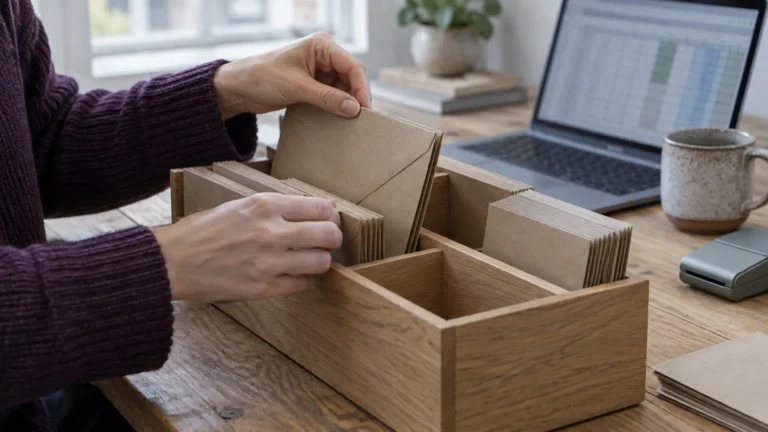
The fix is a hybrid: checking pays fixed bills and online carts, while cash covers groceries, dining out and fun money. On payday, request $600 as twenty-four $20s, eight $10s and eight $5s ($480 + $80 + $40) since ATMs mostly dispense $20s.
When gas or an online order uses a card, move that cash into a deposit pile and return it to checking next bank trip. For cash-free limits or work receipts, use digital pots like Ally’s Spending Buckets or shared envelopes in Goodbudget.
Couples wanting shared money without sharing one app can use a joint bucket account plus one personal fun-money envelope each. That keeps small daily buys friction-free while holding total flexible spending to $600.
Keeping too much cash at home or reaching for a card when an envelope empties
Storing multiple paychecks of cash at home creates a risk from fire or theft, while an empty envelope two days before payday tempts a credit card swipe. Either mistake sets back a household working to quit cards.
Cash in an envelope or home safe is not covered by FDIC deposit insurance, so stolen or burned bills are gone permanently. Covering a mid-paycheck shortfall with a credit card restarts interest charges and wipes out the category boundary.
The fix is keeping no more than one pay period of cash at home and carrying only the envelope for each errand. At month’s end, roll leftover cash into the same category or deposit it toward debt instead of letting a stack grow.
If gas or groceries run short before payday, borrow from fun money, never from a card. When an essential envelope empties early two months running, the cap was set too low, so raise that limit and trim a nonessential category instead.
Letting annual bills and third paychecks derail a two-paycheck budget
Annual bills such as car registration or insurance blow up a $600 paycheck budget when they land unbudgeted in an ordinary week. Treating a predictable yearly cost like an emergency pushes groceries or utilities straight onto a credit card.
Being paid every two weeks brings 26 checks a year, creating two months with a third paycheck that often disappears into impulse spending. Feeding that extra $600 into regular envelopes inflates flexible habits instead of building protection against future card debt.
The fix is dividing annual costs such as insurance by 12 and funding them monthly inside a separate savings account for sinking funds. On third-paycheck weeks, skip refilling flexible envelopes and send that extra $600 straight to savings or a sinking fund.
Quitting in the first 30 days from too many categories and guessed targets
Beginners often abandon a new budget within weeks after linking every account at once, building dozens of categories and guessing limits without checking statements. Setup overload turns a simple spending check into daily bookkeeping right when willpower is thinnest.
Old Mint history also will not follow you automatically because Mint shut down in 2024. The fix is starting lean over your first 30 days and trimming flexible limits 10% to 15% below your three-month average:
- Choose a zero-based planner or cash envelopes to control spending, or a tracker only for account visibility.
- Link only your main checking account and most-used card, or pull three months of statements for paper cash (and download bank CSVs if you need old Mint history).
- Keep to about 10 app categories or four to six envelopes.
- Set each flexible limit 10% to 15% below its three-month average, turning $600 a month on groceries into $510 to $540.
- Spend 15 minutes a week fixing categories and matching balances to your bank.
- Before the trial ends, switch to the annual plan or cancel and move to a free option.
- At month’s end, roll leftover envelope cash into the same category or deposit it toward debt rather than hoarding it at home.