
You stand at the checkout line, watching the total climb higher with every beep of the scanner. According to the Bureau of Labor Statistics, food-at-home prices have increased significantly over the last few years, leaving many households scrambling to stretch their paychecks. When every trip to the local grocery store feels like a raid on your savings account, the allure of the warehouse club becomes hard to ignore. Huge pallets of paper towels and gallon-sized jars of mayonnaise promise a lower unit price, but they also require a yearly membership fee—usually between $50 and $130.
The math only works if you actually use what you buy and the savings exceed the cost of entry. If you spend $65 a year on a Costco membership just to buy a single pack of socks, you have lost money. However, if you strategically target specific categories where the price gap between traditional retail and warehouse pricing is widest, you can recoup your membership fee in a single afternoon. This bulk buying guide identifies the 15 specific items that justify the membership cost and provide the best return on your investment.

The Membership Landscape: Costco vs Sam’s Club vs BJ’s
Before you load up a flatbed cart, you must choose your ecosystem. Each warehouse club has a slightly different personality and pricing structure. Costco remains the gold standard for many due to its high-quality Kirkland Signature private label and legendary return policy. Sam’s Club often offers a lower entry price for membership and integrates technology—like their “Scan & Go” app—that lets you bypass the checkout line entirely. BJ’s Wholesale Club offers a middle ground, often featuring more name brands and a layout that feels closer to a traditional supermarket.
As of late 2024 and early 2025, membership fees have seen slight adjustments. A standard Costco Gold Star membership costs $65 annually, while the Executive tier sits at $130 but offers a 2% reward on most purchases. Sam’s Club starts at $50 for Club members and $110 for Plus members. To make your membership “free,” you need to find $5 to $11 in monthly savings compared to your local Kroger, Publix, or Safeway. If you follow the items on this list, hitting those numbers is remarkably easy.
“The goal isn’t to be cheap—it’s to be intentional.”

1. Gasoline and Fuel
For many members, the savings at the pump alone pay for the membership. Warehouse clubs use gasoline as a “loss leader” to get you into the parking lot. According to data from AAA Gas Prices, warehouse clubs typically price their fuel 10 to 30 cents lower per gallon than neighboring stations. If you drive a vehicle with a 15-gallon tank and fill up once a week, saving just 20 cents per gallon translates to $156 in annual savings. That covers a base membership more than twice over.

2. Rotisserie Chicken
You cannot discuss warehouse savings without mentioning the $4.99 rotisserie chicken. Costco has famously kept this price point stable for years, even as production costs rose. These chickens are significantly larger than the $7 or $9 birds found at traditional grocers. Beyond a quick dinner, a single warehouse bird provides enough meat for several meals—think chicken salad, tacos, or soup—plus the bones for a nutrient-dense stock. It is a strategic purchase that reduces your overall cost per protein gram.

3. Over-the-Counter Medications
The price discrepancy in the pharmacy aisle is staggering. A name-brand bottle of 500-count ibuprofen at a drug store can cost upwards of $15. At a warehouse club, you can often find a two-pack of 500-count bottles (1,000 tablets total) for roughly the same price. This applies to allergy medications, pain relievers, and digestive aids. If your household regularly uses daily allergy pills, the warehouse price is often 80% lower than what you would pay at a standard pharmacy. The Federal Trade Commission often highlights the benefits of generic competition, and nowhere is that more evident than in a warehouse pharmacy.

4. Kitchen Staples: Oils, Flour, and Sugar
If you bake or cook frequently, buying in bulk is a necessity. A 25-pound bag of flour or sugar generally costs a fraction of the price per pound compared to the standard 5-pound bags at the grocery store. High-quality extra virgin olive oil is another standout. Warehouse clubs often source premium oils from regions like Tuscany or Greece and sell them in 2-liter bottles for the price you’d pay for a small 500ml bottle elsewhere. Just ensure you have a cool, dark place to store these items so they don’t lose their quality before you use them.

5. Paper Products (Toilet Paper and Paper Towels)
While the initial cost of a 30-roll pack of toilet paper might seem high, the unit price (price per sheet or price per square foot) is almost always lower. Warehouse brands like Kirkland Signature or Member’s Mark consistently rank high in consumer testing for both strength and softness. Because these items are non-perishable, they represent zero risk of waste. As long as you have the storage space under a bed or in a closet, you are effectively “locking in” a lower price and shielding yourself from future inflation.

6. Tires and Installation
Buying tires is a major expense, but warehouse clubs simplify the process. They often run rotating promotions that offer $70 to $100 off a set of four tires. Furthermore, the membership usually includes perks like free lifetime rotation, balancing, and nitrogen inflation. When you factor in the labor costs and the warranty protection, the “out the door” price at a warehouse club frequently beats specialized tire shops and dealerships by hundreds of dollars.

7. Organic Eggs and Dairy
If your family consumes organic products, the savings in the dairy cooler are substantial. Two-pack cartons of organic milk or five-dozen packs of eggs offer significantly lower per-unit costs. According to the USDA, organic premiums can be steep at traditional retailers, but warehouse clubs leverage their massive buying power to keep these prices accessible. A two-pack of organic milk at a warehouse club often costs the same as a single carton at a high-end natural foods store.

8. Coffee Beans and Grounds
Coffee is a high-margin item at grocery stores. At a warehouse club, you can buy 2-pound or 3-pound bags of whole-bean or ground coffee for a price that rivals the 12-ounce bags sold elsewhere. For a daily drinker, this translates to hundreds of dollars saved annually. If you are worried about freshness, buy the whole beans and grind them in small batches at home—or use the industrial grinders located near the warehouse exit.
9. Spices and Seasonings
The small spice jars at the supermarket are among the most overpriced items in the building. Paying $6 for a tiny jar of cinnamon or garlic powder is a recipe for a depleted budget. Warehouse clubs sell giant containers of these same spices for roughly the same price. Even if you don’t use the entire container within a year, the cost of the “wasted” spice is still lower than the cost of buying multiple small jars. For high-use items like black pepper, sea salt, and cinnamon, bulk is the only way to go.

10. Gift Cards
This is a hidden gem for many beginners. Warehouse clubs sell “bundles” of gift cards for restaurants, movie theaters, and streaming services at a discount. For example, you might buy $100 worth of gift cards for a local pizza chain for only $75 or $80. If you already plan on eating at those restaurants or visiting those theaters, you are essentially getting a 20% discount on your entertainment budget before you even walk through the door.
11. Bacon and Deli Meats
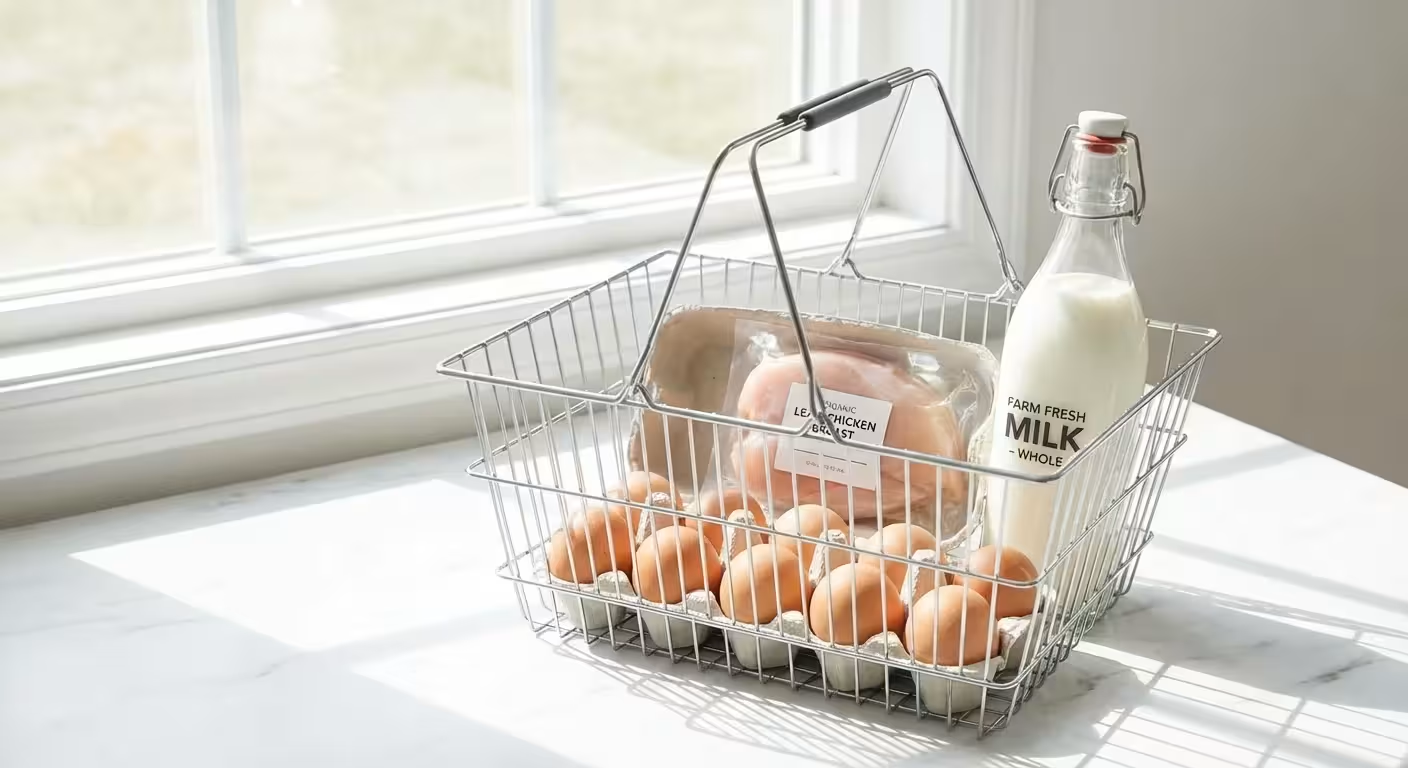
Pre-packaged deli meats and bacon are notoriously expensive per pound at the grocery store. Warehouse clubs sell multi-packs (usually three or four packs bundled together) that drive the price down significantly. Since these items are vacuum-sealed, they have a decent shelf life in the refrigerator, and they freeze exceptionally well. Buying bacon in bulk and freezing the extra packs can save you $3 to $4 per pound.

12. Electronics and Major Appliances
While you don’t buy a TV or a refrigerator every week, one major purchase can pay for years of membership. Warehouse clubs often include an extra year of warranty coverage (sometimes two) at no additional cost. They also typically include “white glove” delivery and installation for appliances, which can cost $100 or more at other retailers. Their return policy on electronics—usually 90 days—is also far more generous than the 15 or 30 days offered by tech-specific stores.

13. Cleaning Supplies
Laundry detergent, dishwasher tabs, and multi-surface cleaners are ideal bulk purchases. These items don’t expire, and the “jumbo” sizes are designed to last a typical family three to six months. By buying the 150-load container of detergent instead of the 50-load bottle, you reduce the packaging waste and lower your cost per load by 30% to 50%.

14. Optical and Hearing Aids
The cost of prescription eyewear and hearing aids is a significant burden for many Americans. Warehouse clubs operate high-quality optical centers where frames and lenses are often half the price of private practices or mall kiosks. Their hearing aid centers are also highly rated for providing top-tier technology at transparent, lower-than-average prices. You often don’t even need a membership to use the pharmacy, but you usually do for the optical and hearing centers.
15. Wine and Spirits
If you live in a state where grocery stores can sell alcohol, the warehouse club is your best friend. Their private-label wines and spirits are frequently sourced from world-class distilleries and vineyards. For instance, Kirkland Signature Champagne is produced in the Champagne region of France and often retails for under $20—a price unheard of for authentic French champagne elsewhere. Even name-brand spirits are usually priced $5 to $10 lower per bottle than at dedicated liquor stores.

Comparison: Unit Pricing in Action
To truly understand the value, you must look at the unit price rather than the total price on the tag. The following table illustrates how buying in bulk shifts the cost of common household items.
| Item | Standard Grocery Price | Warehouse Club Price | Estimated Savings |
|---|---|---|---|
| Ibuprofen (per 100 ct) | $8.50 | $1.50 | 82% |
| Organic Milk (per gallon) | $6.99 | $5.25 | 25% |
| Coffee (per ounce) | $0.95 | $0.40 | 58% |
| Batteries (AA, per cell) | $1.25 | $0.50 | 60% |
| Trash Bags (per bag) | $0.28 | $0.14 | 50% |

DIY vs. Professional: Warehouse Services
When you join a warehouse club, you aren’t just buying products; you are gaining access to services. Understanding when to use these services versus doing it yourself or going to a specialist is key to maximizing your membership.
Tires and Auto: Professional installation at a warehouse is almost always the better deal. While you could buy tires online and take them to a local mechanic, the warehouse’s bundled services (rotations and road hazard protection) provide long-term value that is difficult for a DIYer to replicate. However, for simple things like changing your own wiper blades or air filters, you can buy the parts in the warehouse but should definitely install them yourself to save the labor fee.
Photo and Printing: Most warehouses have shifted their photo services online. While “professional” photographers might offer better artistic editing, for standard prints, canvases, and photo books, the warehouse pricing is unbeatable for the average consumer. It is a classic “good enough for 90% of people” scenario that saves you 40% over boutique printing shops.
Home Improvement: Warehouse clubs partner with professional contractors for things like flooring, HVAC, and solar panels. They offer “shop-at-home” services where you get a warehouse gift card (often 10% of the project value) back as a rebate. This is an excellent way to get a professional job done while effectively “paying” for your membership for the next decade in one go.

Savings Killers: The Traps of Bulk Buying
Buying in bulk is only a winning strategy if you avoid the psychological traps designed to make you overspend. If you aren’t careful, you can end up with a “warehouse hangover”—a $500 credit card bill for items you didn’t really need.
- The “It’s a Deal” Fallacy: Just because a 5-gallon tub of pickles is a great price per ounce doesn’t mean you should buy it. If you can’t finish it before it expires, or if it takes up too much space in your fridge, you have wasted money, not saved it.
- The Impulse Aisle: Warehouse clubs are masters of the “treasure hunt” atmosphere. You came in for eggs and milk, but you left with a 75-inch TV and a new set of patio furniture. Stick to your list.
- Bulk Perishables: Fresh produce in bulk is a major savings killer for small households. Unless you are prepping meals for a family of six, that 5-pound bag of spinach will likely turn into green slime before you reach the bottom. Stick to frozen vegetables for bulk buys instead.
- Unit Price Ignorance: Always check the unit price on the shelf tag. Occasionally, a sale at a traditional grocery store can beat the warehouse price, especially when using digital coupons.
Frequently Asked Questions
Do I need a membership to use the pharmacy or food court?
In many states, laws require pharmacies to be open to the public, meaning you can fill prescriptions at Costco or Sam’s Club without a membership. Policies on the food court vary by location; many now require a membership card to even enter the outdoor or indoor seating areas.
Is the Executive/Plus membership actually worth the extra money?
The math is simple: If you spend more than $3,250 a year ($270 a month) at Costco, the 2% reward will pay for the $65 upgrade cost. If you spend less than that, stick to the basic tier. For Sam’s Club Plus, the free shipping and early hours often provide more value than the cash rewards alone.
Can I share a membership with a friend?
Most warehouse clubs allow two people living in the same household to be on one account. While some people try to “split” a membership with a friend in a different house, clubs have recently become much stricter about checking IDs and photos at the entrance and checkout.
What is the best time to shop to avoid crowds?
To avoid the chaos, shop on Tuesday or Wednesday mornings right after opening. Avoid weekends and the “after-work” rush between 5:00 PM and 7:00 PM, as the long lines can lead to “fatigue shopping,” where you grab extra items just to make the trip feel worth the wait.
A membership at a warehouse club is a tool—not a magic wand. To make the most of it, you must be disciplined about your shopping list and honest about your household’s consumption habits. Start by focusing on the 15 items listed above; they represent the most reliable “wins” for a beginner. Once you see the savings accumulate on your monthly bank statements, you can begin to explore the more niche offerings like travel packages, insurance, and tires. This article provides general money-saving guidance. Individual results vary based on location, household size, and spending patterns. Verify current prices before making purchasing decisions.
Take your most recent grocery receipt and highlight the items you could have bought in bulk. If those savings add up to more than $6, you’ve just found the monthly cost of a membership. The next time you need to fill your tank or restock the pantry, consider making the leap to the warehouse. Your future self—and your bank account—will thank you for the intentionality.
Last updated: February 2026. Prices change frequently—verify current costs before purchasing.









Leave a Reply