You remember the day you signed your lease three years ago. The monthly payment fit your budget, the “new car smell” was intoxicating, and the thought of returning the keys in 36 months felt like a problem for your future self. That future has arrived. As your lease expiration looms in 2025, you face a critical crossroad: hand the keys back to the dealership or write a check to keep the car.
The automotive landscape shifted dramatically between 2022 and 2025. While new car inventory has largely recovered from the shortages of the early 2020s, interest rates and vehicle MSRPs remain high. This economic environment creates a unique opportunity for many lessees. If your car’s residual value—the price set in your contract years ago—is significantly lower than what that same car would cost on a used car lot today, you are sitting on a pile of vehicle equity. Buying out your lease might not just be a matter of convenience; it could be the smartest financial move you make this year.
The Residual Value Equation: Why the Math Might Favor You
When you signed your lease, the finance company estimated what the car would be worth at the end of the term. This number, known as the residual value, is fixed in your contract. It does not fluctuate with market trends. In a normal economy, cars depreciate predictably. However, the last few years have been anything but normal. According to data from the Bureau of Labor Statistics, used vehicle prices saw historic volatility, and while they have stabilized, they remain well above pre-pandemic levels.
To determine if a buyout makes sense, you must compare your contract’s residual value against the current market value. If your lease says you can buy the car for $22,000, but Kelley Blue Book shows that similar models are selling for $26,000, you have $4,000 in “free” equity. If you walk away, the dealership keeps that $4,000 profit. If you buy the car, you capture that value for yourself.
“It’s not your salary that makes you rich, it’s your spending habits.” — Charles A. Jaffe
Being intentional about your lease buyout means looking past the monthly payment and focusing on the total cost of ownership. If you turn the car in, you likely face a “disposition fee” (often $350 to $500) and potential charges for “excessive wear and tear.” Buying the car eliminates these exit fees immediately.

Evaluating Your Car’s True Cost
Before you commit to a car lease buyout, run the numbers through a realistic lens. Use the table below to see how a typical 2025 scenario might look compared to leasing a new equivalent model.
| Metric | Buyout Your Current Car | Lease a New 2025 Model |
|---|---|---|
| Initial Outlay | $0 (if financing the buyout) | $3,000 – $5,000 (Down payment/Fees) |
| Purchase Price | $21,500 (Contract Residual) | $34,000 (New MSRP) |
| Monthly Payment | $420 (60-month loan at 7%) | $525 (36-month lease) |
| Long-term Value | You own the asset eventually | You own nothing in 3 years |
| End-of-Lease Fees | $0 | $400 + potential damage charges |
The table illustrates a common reality in 2025: the cost of stepping into a new lease has outpaced the cost of financing your existing vehicle. Even with higher interest rates on used car loans, the lower principal amount of a buyout often results in a lower monthly obligation than a brand-new lease. Furthermore, you avoid the “acquisition fees” that most manufacturers bake into new lease agreements.
When It’s Worth Paying (and Staying)
Financial logic isn’t the only factor; the condition of your vehicle matters just as much as the math. A lease vs buy decision should be influenced by how you used the car over the last three years. Consider buying your lease in these specific scenarios:
- You went over your mileage limit: Most leases charge between $0.15 and $0.25 per mile over the limit. If you are 10,000 miles over, you owe the dealership $2,000 to $2,500 just to walk away. Buying the car makes those penalties disappear.
- The car is in “rough” condition: If your kids treated the backseat like a cafeteria or you have a few shopping cart dings, the dealership will bill you for “excessive wear.” These charges are often inflated. By buying the car, you decide when and how to fix those issues—or if you can live with them.
- You know the car’s history: A used car from a lot is a mystery. You know exactly how your leased car was driven, whether the oil was changed on time, and if it was ever in an accident. That “peace of mind” has a tangible financial value.
- New car rates are prohibitive: If your credit score has dipped or if manufacturer incentives have dried up, the interest rate on a new lease or loan might be significantly higher than what you can get for a used car refinance.
The Hidden Mechanics of the Buyout Process
Many drivers assume they have to return to the original dealership to execute a buyout. This is a common misconception that can cost you money. In most cases, your contract is with the financing arm of the manufacturer (e.g., Ford Credit, Toyota Financial Services), not the local dealer.
Direct buyouts allow you to bypass the dealership’s “documentation fees,” which can range from $200 to over $800 depending on your state. Call the leasing company directly and ask for a “payoff quote.” This quote includes the residual value, any remaining payments, and applicable sales tax. If your state allows it, handle the paperwork directly with the lender and your local DMV to keep your costs as low as possible.
If you need to finance the buyout, treat it like any other car purchase. Shop for a loan at your local credit union or an online lender before talking to the dealership. According to the Consumer Financial Protection Bureau (CFPB), shopping around for an auto loan can save you thousands of dollars in interest over the life of the loan. Don’t let the dealer mark up your interest rate as a “convenience fee.”
Don’t Fall For These: Common Buyout Pitfalls
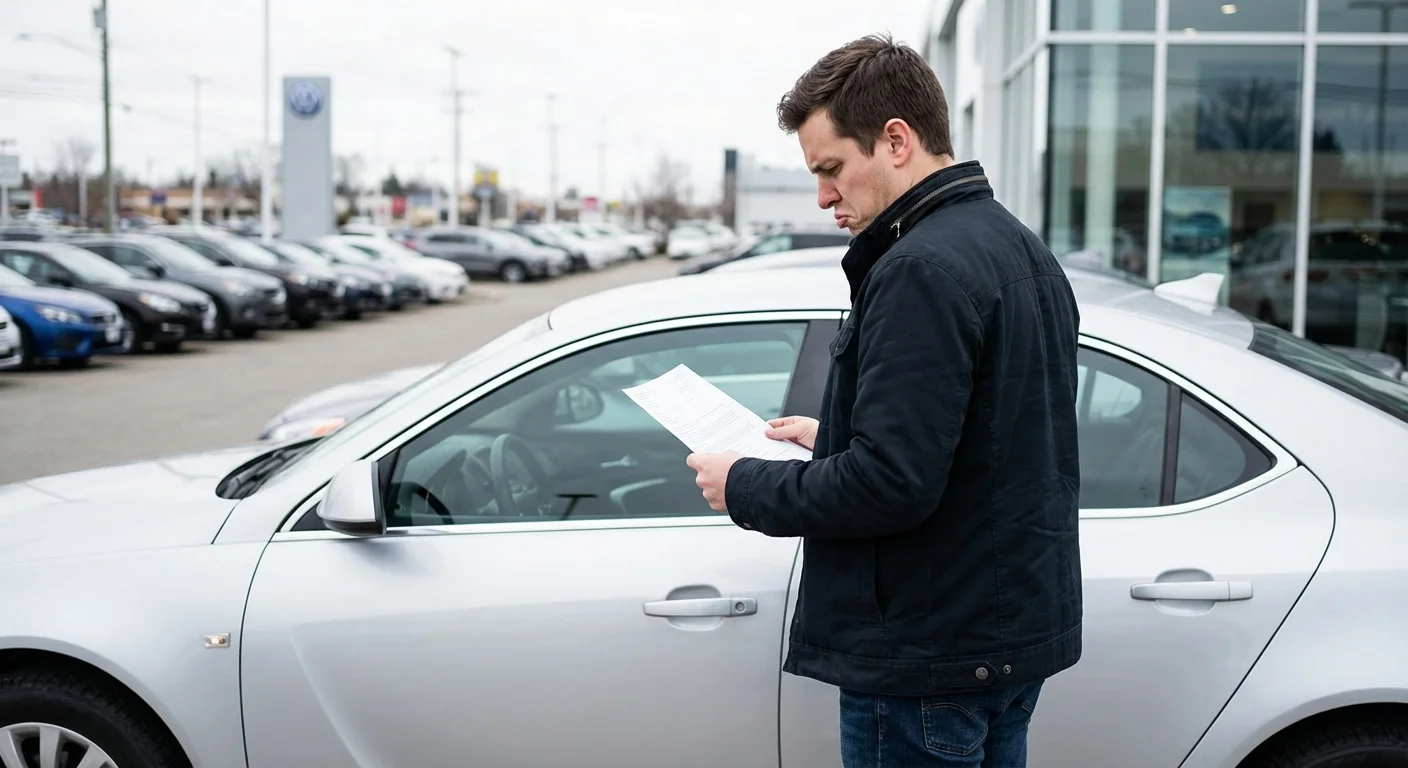
Dealerships are in the business of selling new cars, not helping you keep your old one. They often use specific tactics to discourage buyouts or to extract extra profit from the transaction. Watch out for these red flags:
- The “Mandatory Inspection” Fee: Some dealers claim you must pay for a multi-point inspection to “certify” the car for a buyout. Check your original lease agreement. Usually, no such requirement exists.
- Hidden “Market Adjustments”: A dealer might try to tell you the car is worth more now, so the price has gone up. This is false. Your residual price is a legally binding number established when you first leased the car.
- The Warranty Pressure Cooker: As you transition from a lease to ownership, the finance office will push extended warranties. While some coverage is useful, dealership warranties are notoriously marked up. You can often buy the same coverage independently for 40% less.
- The “Transfer to Purchase” Scam: Some dealers will try to structure the buyout as a “trade-in” where they buy the car from the leasing company and then sell it back to you. This adds extra layers of fees and taxes. Always aim for a “direct purchase” from the lessor.

How to Execute Your Buyout Like a Pro
If you have decided that keeping your car is the right move, follow this timeline to ensure a smooth transition:
Step 1: Get Your Payoff Quote (90 Days Out)
Log into your lease portal or call the captive finance company. Ask for the “total payoff amount” and the “expiration date” of that quote. This gives you a baseline number to compare against market values on Edmunds or other valuation sites.
Step 2: Secure Your Own Financing (60 Days Out)
Check your credit score and apply for a used car loan at a bank or credit union. Having a pre-approval letter in your pocket gives you leverage. In 2025, expect rates to be higher than your original lease’s money factor, so factor that into your monthly budget.
Step 3: Decide on the Sales Tax (30 Days Out)
In most states, you must pay sales tax on the residual value of the car when you buy it. Some states allow you to roll this into the financing, while others require it upfront. Budget for this expense; on a $20,000 buyout, a 7% sales tax adds $1,400 to your total cost.
Step 4: Contact the Lessor to Finalize
If your state allows direct-to-consumer buyouts, the leasing company will mail you the title once they receive the funds. If your state requires a dealer to facilitate the transaction, find a reputable dealer (it doesn’t have to be the one you bought it from) and ask them for their “buyout processing fee” upfront.

Is a Buyout Always the Best Move?
Despite the potential for equity, buying your lease isn’t always the right choice. If your car was involved in a significant accident, its resale value has likely plummeted—even if it was repaired perfectly. Because the residual value in your contract assumes a clean history, you might be overpaying for a car that is “branded” by a bad Carfax report. In this instance, handing the keys back and letting the leasing company take the loss on the diminished value is the smarter financial play.
Additionally, consider the “tech gap.” If you leased an electric vehicle (EV) in 2022, the technology in 2025 models might be vastly superior in terms of range and charging speed. In the fast-moving EV market, older models depreciate faster, and your residual value might actually be higher than the market price. Always check the current resale value before assuming you have equity.

Your Next Steps for a Smarter 2025
Take an hour this weekend to pull out your original lease paperwork. Find the “Purchase Option Price” and compare it to current listings for the same year, make, and model with similar mileage. If the market value is higher than your buyout price, you have a winning hand.
If you decide to keep the vehicle, move quickly on your financing. Interest rates can fluctuate, and locking in a rate early can save you hundreds over the life of the loan. By being proactive, you transform a potentially stressful lease-end into a strategic financial win that puts you in the driver’s seat of your net worth—literally.
The savings estimates in this article are based on typical costs and may differ in your area. Always compare current prices and consider your household’s specific needs.
Last updated: May 2025. Prices change frequently—verify current costs before purchasing.








Leave a Reply